
Our Projects
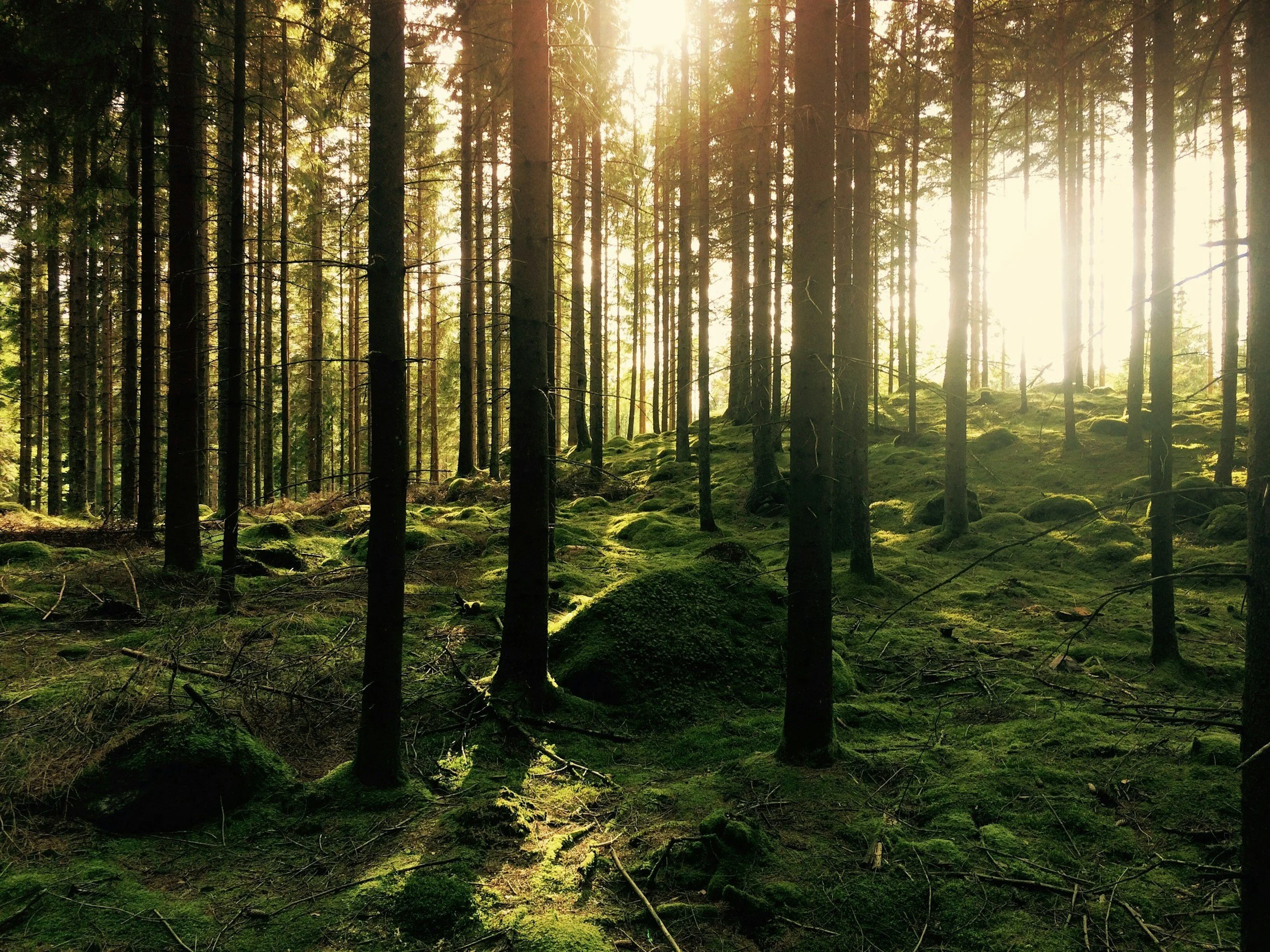
At Noora we know keeping mature forests has an immediate effect. The carbon already stored in the trees stays in the forest, the trees keep removing CO₂ from the air, and the forest remains a home for plants and animals and a place for people to enjoy.
After that, the forest does not go back to conventional clear-cut forestry. It moves to continuous cover forestry (CCF), a close-to-nature approach: only single trees or small gaps are harvested, at lower volumes, so the forest always stays intact. This mimics the natural disturbances in a forest, such as a fallen tree or a small storm gap, and keeps far more carbon in the forest over time.
| Clear-cut forestry (today) | Continuous cover projects | |
|---|---|---|
| Harvest | The whole stand at once | Single trees or small gaps, lower volumes |
| After harvest | Bare land, replanting | The forest stays standing; new trees grow up naturally |
| The forest over 40 years | Young, even-aged forest | Mature, varied forest with trees of all ages |
| Carbon | Most of it leaves the forest at harvest | Much more stays in the forest |
| Nature and recreation | Habitats and paths are lost for decades | Habitats, landscape and paths are kept |
Measured, not modelled: proof that it is additional
We do not just assume what would have happened. The projects stands are measured in the field and compared with similar forests from the National Forest Inventory (NFI). If comparable forests are clear-cut while these stay standing, the difference is the real, additional effect of your sponsorship.
Measure
Sample plots in the projects stands are measured in the field, with precise positioning.
Compare
Each stand is matched with comparable NFI forest plots: same species, site quality, age and volume.
Follow
The comparison is repeated over time, checked by an independent auditor, and you can follow the result year by year.
The figures on this page are Noora’s estimates before measurement. What counts is the measured difference against the comparable forests.
Dynamic baseline – example
Measured in the forest – not modelled. Credits only for carbon gains beyond comparable forests · 1 ha, 1 year, illustrative
1Measure in the forest
Field inventory of the project stand at start, using the same method as the National Forest Inventory (NFI).
2Re-measure after 3 years
We revisit the same plots and measure again – the real change in carbon, not a model estimate.
3Compare with ~10 NFI plots
Matched on age, tree species, volume, growth and slope. Their measured change is the baseline.
4Difference = credits
Carbon gain beyond the baseline, minus buffer and leakage, is issued as credits.
Project stand
Measured carbon gain
10t CO₂
Baseline
Average of ~10 matched NFI plots
2.5t CO₂
6 of 8 comparable stands harvested – the baseline follows real practice, can’t be set low
Result
Additional carbon (gross)
7.5t CO₂
- Credits issued5.25(70%)
- Buffer pool1.5(20%)
- Leakage0.75(10%)
Credits issued
per hectare and year
5.25
t CO₂ = 5.25 credits
- 7.5 gross
- − 20% buffer
- − 10% leakage
- = 5.25 issued
Carbon pools – counted the same way in project and baseline
These are part of the measured comparison, not credits in themselves.
-
Living treesStems, branches and roots
-
DeadwoodDead trees and logs still store carbon
-
Wood products (HWP)Long-lived products like construction timber
- Buffer poolCredits set aside as insurance against storm, fire or pests – never sold.
- LeakageHarvest that may move to other forests – deducted so the effect isn’t overstated.
What else your credit buying protects
Biodiversity
Older trees, more deadwood and a varied forest structure give room for species that disappear after a clear-cut.
Continuous forest cover
The forest is never cleared. The landscape, the forest climate and the soil stay intact.
Soil and water
Less soil disturbance and run-off protects streams, lakes and drinking water.
Carbon stays in the forest
The standing trees keep storing carbon instead of releasing much of it at harvest.
A local forest owner
Most of the money goes directly to a Nordic forest owner who chooses a different way of managing the forest.
Measured, not assumed
Field measurements and independent audits show what actually happens in the forest. You get the results.
How it works
- You purchase carbon credits.
- The forest owner signs a 40-year agreement with Noora not to clear-cut these stands.
- Noora measures the forest, registers the project and has it checked by an independent auditor.
- You receive a yearly report on the forest and are welcome to visit it.

Estimate based on Noora’s forest model, not a guarantee. The yearly amount is a level payment over 40 years with the same present value (2.5% discount rate) as the expected value of the extra carbon these stands store compared with clear-cutting. Clear-cut value: net harvest income today minus replanting and young-forest care. CO₂e: the additional carbon kept in the forest compared with comparable forests (NFI baseline), from the Noora platform’s VM0045 calculation after leakage, uncertainty and buffer deductions; project years 2026–2028.
The sooner we act, the greater the impact.
Captures more carbon
Longer rotations and adjusted harvesting let mature trees keep growing and storing CO₂ from the first year.
Protects biodiversity
Older, more varied forest gives habitat to fungi, lichens, birds and insects that depend on undisturbed ground.
Builds resilience
Healthier stands are better equipped for storms, drought and pests, so the forest keeps working for generations.

Norwegian forests capture CO₂ equivalent to 40% of the country's total emissions. With targeted management practices, this uptake can be significantly increased. These measures are beneficial for society but not profitable for individual forest owners. Carbon credits can change that, making them an important climate tool.
Arne Rørå,
CEO of NORSKOG